Age Verification and 18+ Access on Adult AI Platforms
Age gating on an adult chat platform is signalled in several places at once, and the signals are easier to read than the technology behind them. The clearest are the 18+ labels on filters and content states, the terms attached to the account, and a compliance statement that sets out what the content is. A platform that publishes all three has told you who it is for before you send a message.

Key takeaways
- Three published signals do most of the work: 18+ states and filters, the terms of use, and the 2257 compliance statement.
- The compliance statement confirms the content is AI-generated text and depicts no real person.
- Gating sets an audience, and the content and community guidelines still apply inside that audience.
- A published reporting route per content page is part of responsible access, not an afterthought.
What age gating actually looks like
The first layer is interface labelling. Filters and content states carry an 18+ option alongside Filtered and Unfiltered, which means the age boundary is visible at the point of use rather than buried in paperwork. A reader sees an explicit choice instead of an assumption.
The second layer is the compliance statement. The platform's own page, last updated 8 February 2025, states that the content is AI-generated text, that it does not depict any real person, and that the site does not produce images or video. That is a precise claim about what the product is, and it is also an age statement, because it draws the boundary around a category of content that adults opt into.
The third layer is the account terms themselves. Accepting them is the moment the reader declares their status, and it is worth reading what the platform says it will do if the terms are breached - typically the removal of content and the closing of access through the same routes as any content complaint.
Why the signals matter more than they look
Signals set expectations. A reader who sees an 18+ state, terms that name the audience and a compliance statement knows exactly what kind of platform this is, which is what prevents the mismatch that ends in a complaint. Most disputes in this category come from a reader who expected something different rather than from a technical failure.
They also matter for creators. User-built characters sit behind the same rules, and a platform that publishes a content removal policy with a reporting route on every content page gives creators and readers a shared standard. The support address is the same one used for compliance contact, which keeps the path short.
Finally, they matter for how a reader behaves. Knowing that guidelines apply inside an adult space changes what you write, because the boundary is about legality and consent rather than about taste. Nothing here is exotic, and all of it is checkable in a few minutes.
What verification can and cannot establish
Device-level gating - an 18+ label, a terms acceptance, a prominent statement - establishes the audience a platform is built for. It is a declaration rather than a proof of age, and honest reporting of that distinction is more useful than any overstatement in either direction.
What it does establish is accountability. A platform that states what its content is, who it is for, how to report content and where to complain has made itself answerable. That is the part a reader can verify: look at the compliance page, look at the removal policy, look at the complaints route, and see whether they agree with each other.
What it cannot do is replace the reader's own responsibility. The audience for this category is adults, and the clearest signal that a reader belongs is simply that they are one.
| Signal | Where it appears | What it establishes |
|---|---|---|
| 18+ content state | Filters beside Filtered and Unfiltered | An explicit audience choice at the point of use |
| Compliance statement | Page updated 8 February 2025 | Content is AI-generated text and no real person is depicted |
| Account terms | At sign-up | Who may hold an account |
| Content removal policy | Reporting route on each content page | How and where to raise a concern |
| Complaints policy | Site policy page | Where escalation goes next |
Four of the five rows are things a reader can check without an account. That is the practical test when comparing platforms: the paperwork should be visible before commitment, not after.
Start any comparison with that paperwork rather than with the interface. The statement, the removal policy and the complaints route are short documents, and reading them takes less time than opening three character cards. A platform whose public pages agree with each other has given you a reason to continue; one whose pages contradict each other has given you an answer already.
Worked example: reading the audience from the counters
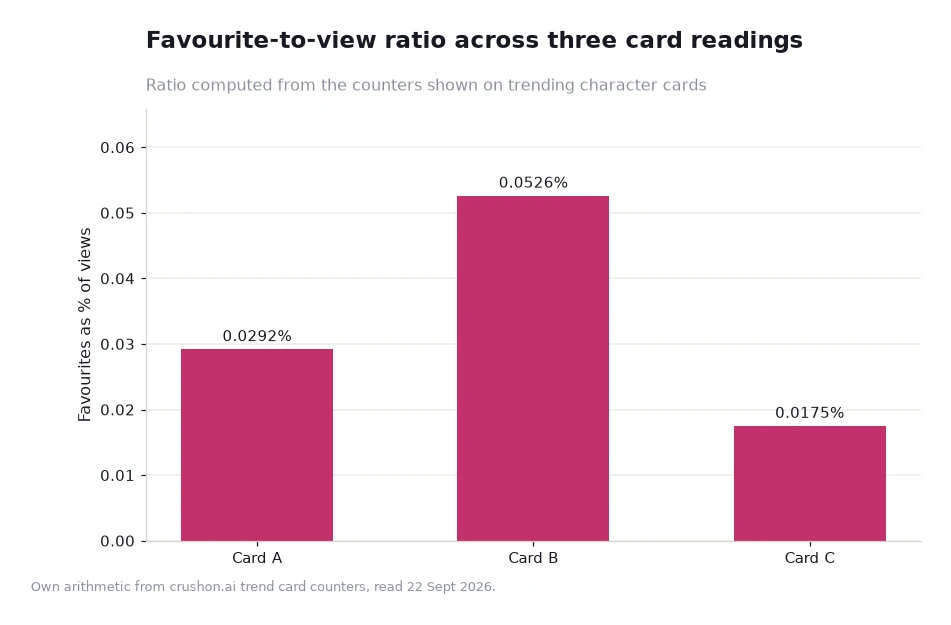
The counters give a rough sense of scale at which a gated catalogue operates. Saves as a share of views across three card readings come in at 0.0292%, 0.0526% and 0.0175%. Per 10,000 views those figures are 2.92, 5.26 and 1.75 favourites, and the spread between the strongest and weakest is a little over three to one.
Now compare that with the top of the range. The most-viewed card on the list carries 24.3M views, and at 0.0292% that is roughly 7,100 favourites, which matches the counter shown on the card. The arithmetic is a sanity check rather than a forecast: it confirms the ratios, and it shows how a large but age-gated audience still produces a small, deliberate set of saves.
The lesson is about proportion rather than volume. A gated catalogue does not need a huge save count to be useful; it needs a predictable one, and the ratio is what a reader can actually verify.
Checking the signals yourself
A ten-minute review is enough. Read the compliance statement, open the content removal policy, find the complaints route, and confirm that the filters you use carry an 18+ state. Then look for the content guidelines, because gating names an audience while guidelines describe behaviour inside it.
For the platform used as the example throughout this piece, that means the page describing ai porn chat and its Porn Chat AI framing, which sets out what the product is in the client's own words, alongside the 2257 compliance statement that confirms the content is AI-generated text. Two pages, a few minutes, and the audience question is answered.
Readers who make that check a habit when they try a new platform will find the category much easier to navigate. The labels, the terms and the statement are all published, and reading them is the whole method.
Frequently asked questions
How do I confirm a platform is adults-only?
Look for three things: an 18+ state among the content filters, terms that name the audience, and a compliance statement describing the content. All three are usually public.
What does a compliance statement establish?
On this platform it states that the content is AI-generated text and does not depict any real person, which also confirms that no images or video of people are produced by the site.
Does gating mean there are no content rules?
No. An 18+ audience is a separate question from content rules, and the platform states that some limitations apply under its content and community guidelines.
Read the labels, then decide
Before using any adult AI platform, spend the few minutes it takes to find the age signals and the policies behind them. If the audience, the content description and the reporting routes are all published and consistent, you have enough information to make a decision; if any of the three is missing, that absence is the answer. Written for an adult audience of 18 plus.
Sources: the content states, the compliance page dated 8 February 2025 and the trending counters behind the 0.0292%, 0.0526% and 0.0175% ratios were read from Crushon on 22 Sept 2026, and the per-10,000 view figures are arithmetic on those counters alone.[1]