Medical-supply documentation is useful only when it belongs to the exact product, manufacturer, revision, and destination market being purchased. A catalog sheet or quality certificate cannot substitute for product-specific evidence. Buyers should first establish whether an item is regulated as a medical device in the target country, then assign qualified regulatory review before ordering.
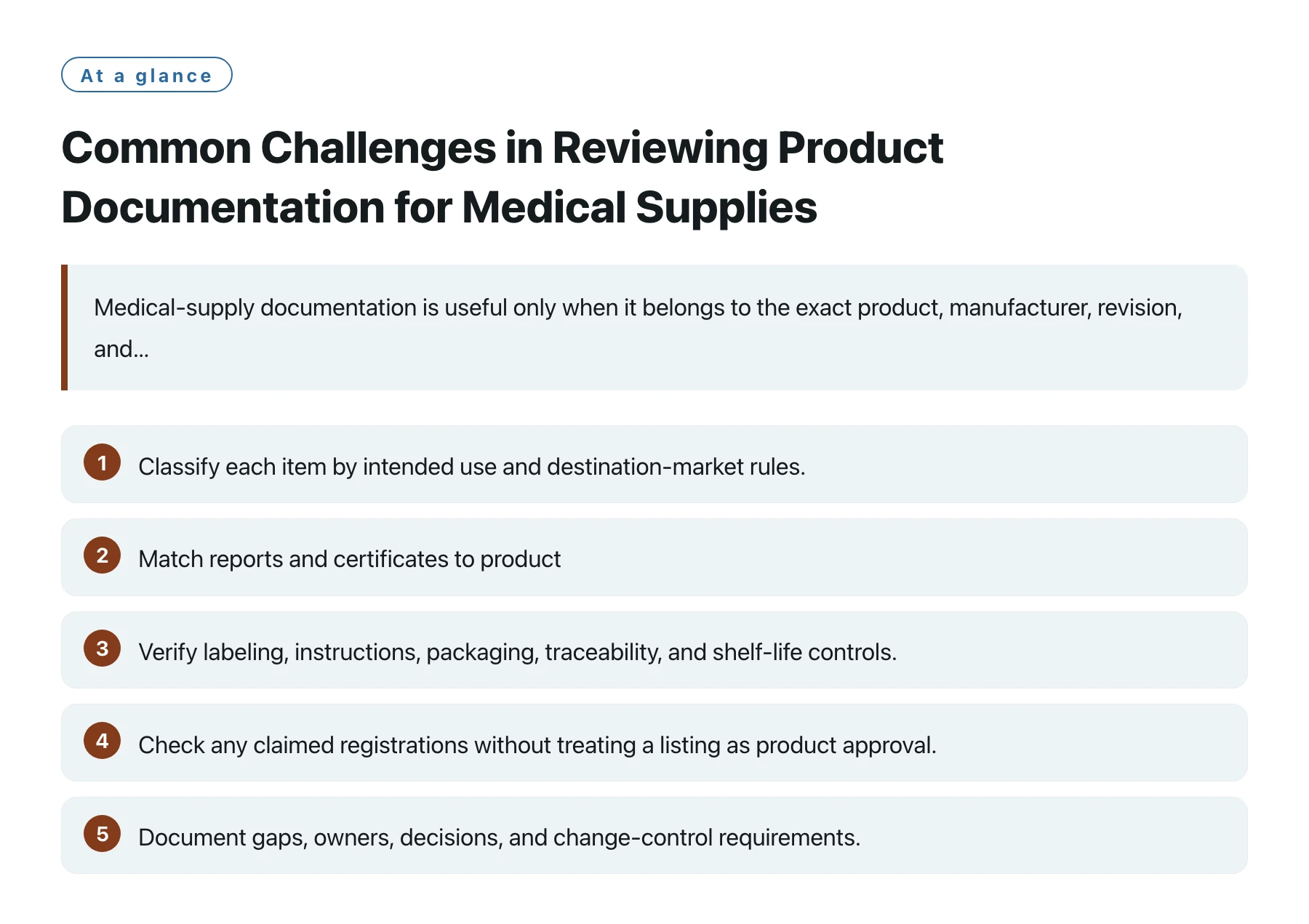
Key takeaways
- Classify each item by intended use and destination-market rules.
- Match reports and certificates to product, manufacturer, plant, model, revision, and lot.
- Verify labeling, instructions, packaging, traceability, and shelf-life controls.
- Check any claimed registrations without treating a listing as product approval.
- Document gaps, owners, decisions, and change-control requirements.
A consistent document review ties each claim and report to one controlled product, manufacturer, revision, and market.
1. Identify the product and intended use
Create a line-by-line inventory with product name, model, intended use, user, patient contact, sterility status, accessories, and destination country. Terms such as “medical supply” can cover products with very different regulatory treatment. Have the importer’s qualified regulatory owner determine the applicable classification and obligations.
Do not assume that a generic item name or supplier’s category determines the legal status. A product marketed for a medical purpose may trigger requirements that do not apply to a general consumer product. Keep the intended-use statement consistent across the quote, labeling, website, instructions, and shipping records.
2. Match every document to the offered product
Ask documents to identify manufacturer, manufacturing site, product or model, revision, scope, date, issuing body, and destination. Compare them against the purchase order and physical sample. A quality-system certificate can describe an organization or scope; it does not by itself establish that a specific device is authorized for a market.
For test reports, check methods, sample identity, laboratory, results, deviations, and whether the exact configuration was tested. Flag reports issued for a different factory, material, model, or product family until a qualified reviewer determines whether they apply.
3. Separate quality-system claims from product evidence
Request current quality-system documentation and confirm its scope, covered site, validity, and issuing organization. Then request product-level evidence separately: specifications, risk or performance records where applicable, biocompatibility evidence when relevant, sterilization validation, packaging validation, and shelf-life support. The needed set varies with product and market.
A certificate logo or registration number should be independently checked with the issuing organization or official database when available. Keep the result and date. Do not describe a registration, listing, or quality certificate as government approval unless the authority explicitly grants the applicable authorization.
4. Review destination-market status carefully
Requirements depend on product type, intended use, and jurisdiction. For U.S. medical devices, FDA explains that foreign manufacturers must meet applicable requirements such as establishment registration, device listing, quality-system obligations, and premarket requirements where applicable. FDA registration or listing alone does not denote approval of the establishment or product. [1]
This U.S.-specific overview does not replace a review of another country’s rules or a product-specific determination. Ask the importer’s regulatory lead to confirm the correct pathway, responsible parties, labeling, and evidence before commercial release. Do not rely on a supplier’s blanket claim that a product is “FDA approved.”
5. Check labeling, instructions, and traceability
Review product labels, package labels, instructions for use, warnings, storage conditions, lot or serial identification, manufacture or expiry dates, and language requirements. Match artwork to the approved product and market. For sterile products, confirm sterile barrier, sterilization method, validated packaging, and handling details appropriate to the product.
Agree how lot numbers connect to production records, certificates of analysis or conformity, and delivery documents. Define retention and recall contacts. If shelf life matters, confirm dating format and remaining-life threshold at shipment and receipt.
6. Verify materials and performance claims
Specify critical dimensions, composition, functional performance, compatibility, packaging, and acceptance criteria. For patient-contact products, sterile goods, or products exposed to fluids, chemicals, or repeated use, have specialists identify the appropriate evidence. A generic material declaration does not prove suitability for every contact or processing condition.
Check whether the test uses the same material, manufacturing process, sterilization cycle, packaging, and product configuration as the offered unit. Record conditions, sample counts, limits, results, and report scope. Treat unsupported claims such as “hospital grade” or “medical quality” as open questions.
7. Manage suppliers, subcontractors, and changes
Confirm who is the legal manufacturer, contract manufacturer, specification developer, importer, and distributor as relevant. Map critical outsourced processes such as sterilization, testing, packaging, or labeling. Verify that responsibilities and records are clear before orders are placed.
Require advance notification of changes to site, materials, components, process, sterilization, packaging, label, or critical supplier. Decide which changes require updated evidence or approval. Keep a document register with version, expiry or review date, owner, status, and affected products.
8. Close documentation gaps before shipment
Use a gap log listing required document, current file, product match, open question, owner, and due date. Separate commercial review from regulatory acceptance. Do not release a shipment with a critical unresolved authorization, labeling, traceability, or product-identity gap.
The FDA describes distinct obligations for foreign manufacturers and initial importers of devices into the U.S.; responsibilities depend on the party and product role. Confirm the applicable rules for the actual transaction and destination, and retain evidence of the decision. [1]
9. Keep the procurement record audit-ready
Store approved specifications, quotations, samples, declarations, test reports, regulatory decisions, label artwork, purchase orders, lot records, inspection results, and correspondence under consistent product identifiers. Record which revision governed each purchase and who accepted any deviation.
Buyers comparing medical supply manufacturers in China can use one document matrix across candidates, but final regulatory acceptance belongs to qualified owners for each destination. Recheck controlled documents when product identity, market, manufacturer, or regulations change.
Sources
Frequently asked questions
Does a quality certificate prove a medical supply is approved?
No. It may cover a quality system or defined scope; confirm the product-specific authorization and evidence required for the destination market.
Does FDA device listing mean the product is FDA approved?
No. FDA states that establishment registration and device listing do not denote approval of the establishment or product.
Which documents should be checked first?
Start with product identity, manufacturer and site, intended use, destination status, labeling, lot traceability, and reports tied to the quoted configuration.
Can a supplier reuse a test report for a changed product?
Only after a qualified review confirms the change does not invalidate the report scope, method, results, or applicable regulatory evidence.