Distillery Kit for Brewers Adding a Spirit Line
A brewer who adds a spirit line is not building a second brewery; the wash is made on equipment the brewery already owns, and the new money goes into distillation, cooling and storage. The manufacturer's range already includes distillery equipment alongside the brewing side, which means the shared utilities can be planned before the still is ordered. A 1,000 L wash at 8 per cent alcohol carries about 80 L of pure alcohol, and that single figure sizes most of the addition.
Key takeaways
- Distillation starts where brewing ends: the mash, fermentation and wash handling already on site usually stay in use.
- Cooling and steam are the two utilities that change most when a still is added, because both run for longer than a brew day.
- Cleaning is shared, so spirit-side vessels and pipework should be designed into the same CIP routine rather than cleaned by hand.
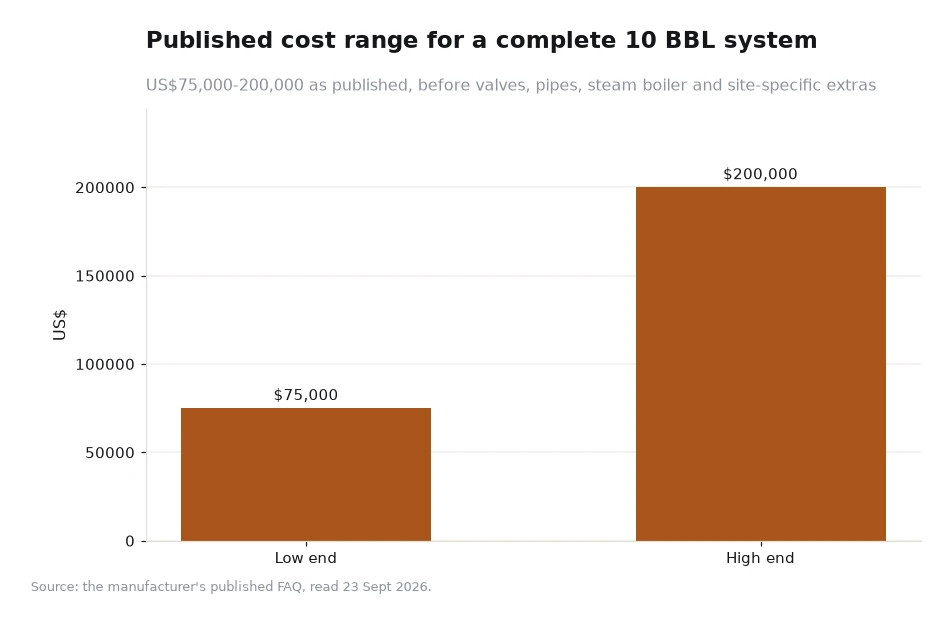
- The only price the manufacturer publishes is the 10 BBL brewery range of US$75,000 to US$200,000, plotted below; a distillery addition needs its own quotation.
What a brewer already owns, and what is new
The brew house side of a distillery is familiar ground: grain is milled, mashed and lautered, the wort is fermented, and what comes out is a wash rather than a beer to package. A brewery adding spirits therefore reuses its mash and lautering vessels, its fermentation tanks, its pumps and its cleaning routine for the front end of the process, and adds the back end: a still, a condenser, a collection vessel and somewhere to put the spirit.
Hermann builds distillery equipment as part of a wider range that also covers malting equipment, bright tanks, canning, bottling and kegging machines, filtration, yeast enlargement, CIP cleaning and control systems. That breadth matters for an expansion project, because the same supplier can describe how the new vessels tie into the existing piping, the existing glycol circuit and the existing steam or electric heating rather than treating the still as a standalone box.
The dividing line to draw early is between a wash still run and a brew day. A brew day is a series of heating and cooling steps of moderate length; a distillation run holds a steady heat input for hours and then condenses vapour that has to be cooled continuously. The building notices the difference in its steam demand, its cooling water and its ventilation long before it notices the new vessels.
The utilities that change
Work through the services in the order they are used. Heating first, because distillation runs longer than mashing and boiling combined on the same batch volume. Cooling second, because a condenser needs a steady flow and a cold jacket is usually wanted on the collection side as well. Cleaning third, because spirit-side equipment still has to be washed, and a site that already runs a CIP circuit will want the new vessels on it.
| Service | Already on site for brewing | What the spirit line adds |
|---|---|---|
| Steam or hot water | Mash and boil heating | A longer steady heat input for the distillation run |
| Cooling and glycol | Fermentation temperature control | Condenser cooling water plus a cold collection side |
| Cleaning | CIP circuit and washdown | Spirit-side vessels and pipework on the same routine |
| Floor and access | Tank farm and packaging space | Still, collection vessel and barrel or cask storage |
| Electrical supply | Pumps, panels and chillers | Heavier load and a dedicated circuit for the still |
Order of operations on a live site
An expansion that keeps brewing while the spirit line goes in needs a sequence, and the sequence is decided by the utilities rather than by the delivery dates. Break into the steam or heating circuit before the still arrives, not after, because a brewery running production will not want a second shutdown a month later. Run the condenser cooling water and the drain for it at the same time, since both are wet trades and both are cheaper before the floor is finished around new tanks.
Set the delivery into the published production calendar as well. Brewery equipment is quoted at 90 to 150 days from deposit to door depending on the order, and a distillery order placed on top of a brewery order competes for the same production slots. Ordering the front end of the project first, and the still after the building work is finished, is a common way to keep both timelines honest.
What the equipment itself should do
The published brewing equipment advantages are a fair description of what to look for on the distillation side too: vessels designed around the customer's process rather than a catalogue size, heating and cooling arranged around the method actually used, and control that follows the recipe automatically. On the spirit side, add the questions a brewery does not normally ask: how the still is heated, how the condenser water is returned, how the collection vessel is cooled, and how both are cleaned between runs.
Worked example
Worked example, with every assumption labelled. Take a 1,000 L wash fermented to 8 per cent alcohol by volume. The pure alcohol in that wash is 1,000 L multiplied by 0.08, which is 80 L. Assume 85 per cent of it is recovered across the distillation run: 80 L multiplied by 0.85 gives 68 L of pure alcohol. The yield and strength assumptions are mine, not manufacturer figures.
Bottle that 68 L at 40 per cent alcohol by volume and you have 68 divided by 0.40, or 170 L of bottled spirit. Fill it at 60 per cent instead, as cask strength, and the same 68 L gives 68 divided by 0.60, or about 113 L. The difference between those two numbers is a packaging decision rather than a distilling one, and it is the kind of arithmetic worth doing before the still is specified.
Set that against the brewery side of the project for scale. The only price range the manufacturer publishes is the 10 BBL example, US$75,000 to US$200,000 for a complete brewery system before valves, pipes, steam boiler and site-specific extras, which is what the chart below plots. A distillery addition is a separate quotation with its own scope, so treat the brewery range as context for the project budget rather than as a figure for the still. The litre and percentage arithmetic above is labelled planning work; the price range is the manufacturer's published one.
Frequently asked questions
Can a brewery add a still to equipment it already owns?
Yes. The mash, lautering and fermentation side of a distillery is the same work a brewery already does, and the manufacturer publishes distillery equipment as part of the same range, so the front end of the process can stay on the existing vessels.
Which services have to be upgraded first?
Heating and cooling change most, because a distillation run holds a steady heat input for longer than a brew day and the condenser needs continuous cooling water, so both circuits are usually the first items on the expansion plan.
Planning the addition as one project
Write the utility list before the equipment list, then ask for a scope that covers both the brewery side and the spirit side in a single layout drawing. The published micro brewery equipment family is where the vessels, cooling and CIP items sit, and the wider company profile explains the design service offered with it. When the utility list is settled, take it to the contact page with the site drawings and the batch volume you intend to distil.
Sources for this article, read from the manufacturer's own website on 23 Sept 2026: the distillery equipment and CIP and control families in the product range, the design-led approach to heating and cooling, the published 90 to 150 day delivery window, and the 10 BBL price range of US$75,000 to US$200,000 shown in the chart.[1] The wash, recovery and bottling arithmetic is labelled planning work by this page.