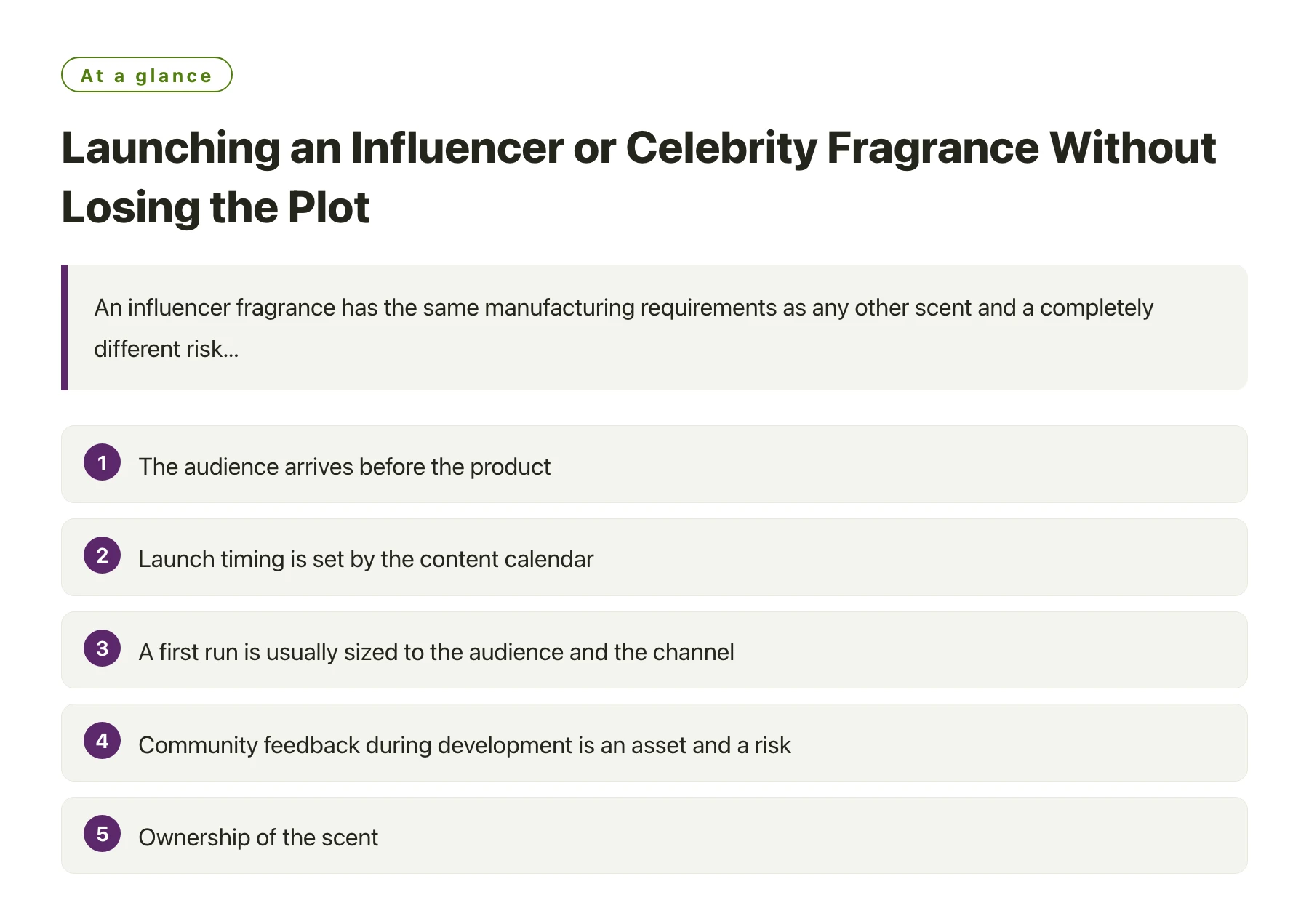
An influencer fragrance has the same manufacturing requirements as any other scent and a completely different risk profile. Demand appears before the product exists, the audience expects the creator's voice to be present in the product, and the launch window is tied to a content calendar rather than to a retail season. Treating it as a normal private label project with louder marketing is how these launches run late.
Key takeaways
- The audience arrives before the product, so the brief must translate a creator's voice into a scent direction rather than a list of notes.
- Launch timing is set by the content calendar, which makes packaging lead times the critical path rather than production.
- A first run is usually sized to the audience and the channel, not to a retail buyer's shelf plan.
- Community feedback during development is an asset and a risk, since public sampling creates expectations the final formula may not meet.
- Ownership of the scent, the name and the formula should be settled early, because these brands often outlive the initial campaign.
Fragrance has become a standard move for creators with a large audience. The appeal is straightforward: a scent is a product with high perceived value, a repeat purchase pattern and a natural fit with the way creators already talk about taste and identity.
The complications are less obvious. Creator-led brands compress the development timeline, place packaging on the critical path, and often expose the formula to public comment before it is final.
This article sets out what is genuinely different about the model and how to plan a first launch so the content calendar and the production schedule do not fight each other.
What is actually different about a creator-led launch
The manufacturing process is the same as any other fragrance. What differs is the order in which things happen, and who is waiting for the result.
Demand exists before the product does
A conventional brand builds awareness after launch. A creator-led brand usually arrives with an audience that has already been told a product is coming, which shrinks the marketing problem and enlarges the delivery risk.
That inversion is why a missed ship date hurts more here. There is no quiet launch to hide in; the delay happens in public, in front of the people who were going to buy.
The voice has to survive translation
A creator's appeal is specific and hard to paraphrase. A brief that says modern and fresh will produce a competent scent that could belong to anyone.
The more useful approach is to build the brief from the creator's own language: the references they already use, the memories they return to, the things they say they dislike. Industry bodies that run perfumery education publish material on how scent is described and evaluated, which can help turn that language into something a perfumer can act on [1].
The run size is set by the audience
Retail listings usually require a minimum quantity and a sell-through commitment. A creator-led launch can size its first run to a known audience and a direct sales channel.
That flexibility is an advantage, but it only works if the packaging choice allows a small run. Custom moulds may force a quantity the audience cannot absorb in one drop.
A launch sequence for a creator fragrance
- Translate the voice into a written briefWork from the creator's own references and dislikes, and put the target wear behaviour in writing before any sampling begins.
- Size the first run to the audienceEstimate demand from the existing channel rather than from a retail plan, and confirm that the packaging choice supports that volume.
- Choose packaging that can move fastStock bottles and standard closures keep the schedule realistic; custom moulds should be justified by something the audience will actually notice.
- Decide the sampling policy earlyDecide whether the scent will be shown publicly during development, and who is allowed to describe it, before the first sample leaves the building.
- Plan the content around the production milestonesBuild the content calendar backwards from the confirmed shipping date, not from the announcement date.
- Confirm ownership and the second productSettle who owns the formula and the name, and confirm whether a second scent or a body product is planned so components can be shared.
Public sampling is the most common way creator launches go wrong. Showing a formula mid-development generates engagement, and it also freezes an expectation that later revisions will break. If the audience tastes version two, they will compare version three against it and may prefer the one that was never intended for sale. If you plan to share the process, separate the content from the product: show the bottles, the lab and the process, and keep the scent itself private until it is approved.
Sourcing and compliance, without the romance
Creator-led brands often start with a small team and a tight budget, which makes the unglamorous parts of the project the ones most likely to be underestimated.
The manufacturer becomes the product team
Without an in-house development function, the factory carries the brief, the formula, the packaging coordination and the filling. Development houses such as Xuelei Perfumes handle sampling, filling and packing as a package, which is usually the right fit for a launch with no internal product staff.
The trade-off is dependence. A brand that intends to grow should make sure it holds the specification and the approved reference, so it is not starting from nothing if it changes supplier later.
Compliance is not optional because the launch is digital
Selling directly to consumers does not change the product rules. Published safety standards set limits on how fragrance materials may be used in each product category [2], and labelling obligations follow the market where the customer lives.
Industry media covering beauty and personal care regularly report on how these requirements shift and what they mean for small brands [3]. The practical point is that a launch plan should name its markets explicitly, since the paperwork follows the destination.
Speed comes from scope, not from shortcuts
The launches that hit their date usually reduced what they attempted rather than compressing what they checked. One format, one scent and a simple pack will move far faster than a range with three concentrations and a custom mould.
Larger fragrance houses segment the market carefully by category and price tier, and that segmentation exists because different price points genuinely support different levels of development [4]. A creator brand is not exempt from that logic just because the audience is warm.
Where the two launch models diverge
| Dimension | Conventional brand launch | Creator-led launch | What to plan for |
|---|---|---|---|
| Demand | Built through retail listing, sampling and advertising after launch | Present before the product ships, through an existing audience | Delivery reliability becomes the main marketing risk |
| Timing | Set by retail seasons and buying calendars | Set by the content calendar and audience attention | Work backwards from a shipping date, not an announcement date |
| Run size | Usually driven by retailer minimums and forecast | Sized to a known audience and direct channel | Choose packaging that allows a smaller first run |
| Product narrative | Constructed by the brand team | Carried by a person whose voice is already established | Translate that voice into the brief rather than into the label copy alone |
| Development visibility | Usually private until launch | Often shared publicly as content | Decide the sampling policy before the first sample is shown |
| Longevity of the brand | Assumed to continue indefinitely | May outlast the campaign that created it | Settle formula and name ownership from the start |
The last row is the one most often overlooked. Creator-led brands that succeed usually become ordinary brands, and by then the questions of who owns the formula and who can use the name matter as much as they would in any other business.
Sources
- The Fragrance Foundation —— A non-profit organisation for the fragrance industry, running perfumery education programmes and industry recognition.
- IFRA Standards Library (International Fragrance Association) —— The IFRA Standards Library lists the restrictions the fragrance industry applies to individual fragrance ingredients, based on safety assessments; it is the reference point for compliant fragrance formulation.
- Cosmetics Business —— A trade publication covering the beauty and cosmetics industry, including fragrance launches and regulatory developments.
- Givaudan —— One of the largest fragrance and flavour houses; public material on fragrance creation, ingredient portfolio and market segments.
Frequently asked questions
Does an influencer fragrance need its own formula?
Not necessarily. Many launch from an existing library formula with exclusive packaging and a strong narrative. A bespoke scent becomes worthwhile when the creator's identity is the main reason people will buy, since then the product itself has to carry that identity.
How large should the first production run be?
Large enough to cover demand for the launch window and the following restock, and small enough that unsold stock does not become a problem. The constraint is usually packaging: custom moulds force a minimum quantity that stock components do not.
Should the scent be revealed before launch?
Reveal the process rather than the formula. Sharing the bottle, the development lab and the sourcing story builds interest without freezing an expectation. Showing unfinished scent samples publicly invites comparisons that later revisions cannot satisfy.
Who owns a celebrity or influencer fragrance formula?
It depends on the contract. Manufacturer library formulas often stay with the manufacturer and are licensed, while bespoke formulas can be assigned to the brand. Because these brands tend to outlive the original campaign, ownership and exclusivity should be settled before development begins.
What is the biggest cause of delay in creator fragrance launches?
Packaging rather than production. Custom bottles, caps and printed cartons carry tooling and longer lead times than the fragrance itself, and a late change to the pack design resets most of the schedule. Choosing components early is the most effective way to protect the launch date.