Buying Compute by the Container: How a Procurement Lead Vets Hosting
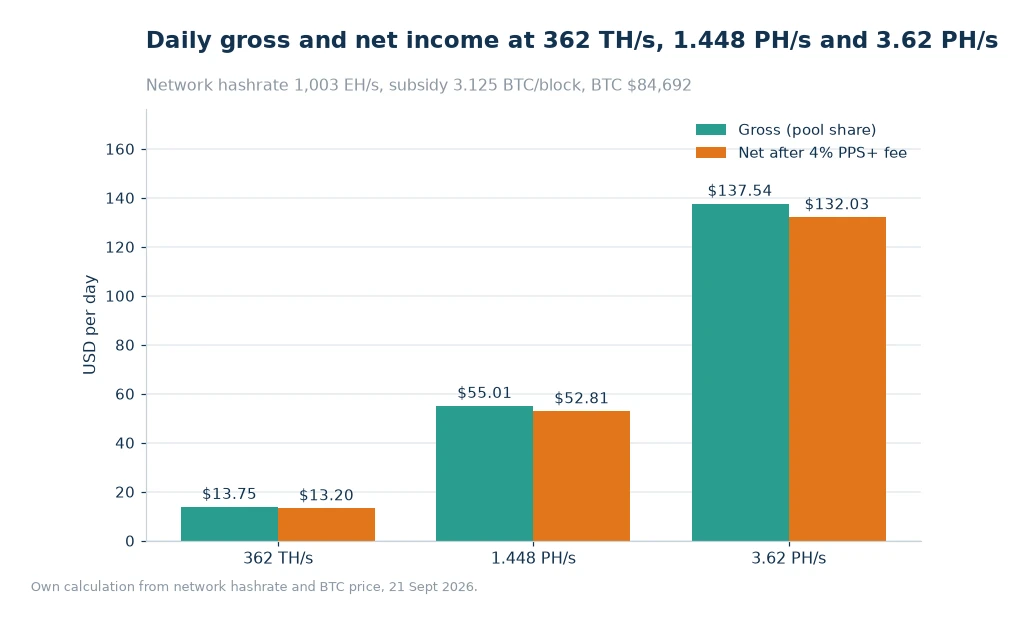
A hosted fleet near 362 TH/s earns about 0.0001624 BTC a day at current difficulty, $13.75 gross. After the listed 4% on the block-reward component, $13.20 remains. Procurement's job is ensuring the hosting invoice never eats that margin unnoticed.
Key takeaways
- 362 TH/s earns 0.0001624 BTC daily: $13.75 gross, $13.20 net at $84,692 per coin.
- 1.448 PH/s scales to $55.01 gross and $52.81 net; 3.62 PH/s reaches $137.54 and $132.03.
- Mining Companies and Miner Hosting pages map the vendor landscape from the buyer's side of the table.
- Uptime guarantees and repair terms move total cost more than headline power prices do.
What procurement actually buys
Nobody purchases coins from a hosting vendor; the pool pays those by formula regardless of address. What the purchase order covers is floor space, megawatts at an industrial tariff, engineered cooling, physical security and technicians who answer alarms. At 362 TH/s the daily output is 362 × 0.00000044865 = 0.0001624 BTC, worth $13.75 before the listed 4% and $13.20 after it — identical in a shed or a hall. The vendor changes the cost of producing that figure, never the figure itself.
Frame every bid accordingly: gross income is fixed by hashrate and difficulty (1,003 EH/s network, 132.76 T at the reading, next adjustment near −2.12%), while the invoice is negotiable. Vendors who imply their facility earns more per terahash are misdescribing the product. Buy concrete inputs — kilowatt-hours, uptime, hands — and let the pool handle the coins.
Mapping vendors before requesting quotes
Shortlist from both sides of the directory: the ViaBTC Mining Companies pages describe firms operating at scale, while Miner Hosting listings cover providers that rack third-party machines. The Mining Farms listings round out the picture with slot-style offers. Three lenses, one market — cross-reference candidates across all of them before sending a single request for quotation.
Check each candidate's scale signals: published capacity, years operating, incident history, client turnover hints. A vendor near 3.62 PH/s of managed weight thinks in the $132-a-day-net terms of this article's top rung; a vendor of single containers thinks in the $13.20 terms of the bottom rung. Match the vendor's typical client size to your own fleet, or expect to be either neglected or overcharged.
Converting every bid to dollars per day
Bids arrive in incompatible units — per machine monthly, per kWh, per kW of capacity, plus setup and repair schedules — so normalize each to an all-in daily cost at your exact hashrate. A quote of $90 per machine per month for 362 TH/s-class units is $3.00 a day against $13.20 of net, before power. A $0.07 all-in kWh quote for a 7 kW shelf is $11.76 a day against the same $13.20. Suddenly the cheaper-looking bid is not.
Add the power line honestly using metered draw, not datasheet optimism, and include cooling surcharges where contracts separate them. Then hold the total against the chart's net column: $13.20, $52.81, $132.03 across the three scales. Any bid whose all-in daily cost approaches the matching net figure fails basic arithmetic. Reject it in one email and move on.
Contract clauses worth more than discounts
Four clauses decide real cost: the uptime commitment with remedies, repair turnaround with parts responsibility, minimum term with exit notice, and prepayment discount terms. A 98% uptime promise without credits for misses is advertising, not a term — at $13.75 daily gross per 362 TH/s, each dark day costs real coins at 0.0001624 BTC. Demand the remedy in writing: fee rebates, free extension days, or termination rights.
Prepayment deserves its own skepticism. A year paid upfront is an unsecured loan to the vendor, sensible only at a discount exceeding your alternative return. Shorter terms with clean exit rights usually beat longer terms with mysterious savings. Procurement veterans weight the exit clause above the price line, because hardware generations turn over faster than five-year contracts assume.
Verifying output after the move
Keep the pool account in company name from day one and reconcile the first hosted fortnight against the 0.0001624 BTC daily standard per 362 TH/s. The Profit Calculator converts live difficulty into expected dollars for the comparison, separating vendor performance from network drift. A well-run hall shows fuller days than the shed baseline; anything else triggers the remedy clause, not a debate.
Track rejected-share rates by worker as well as raw hashrate: a hall with flaky networking can show full terahashes while submitting stale shares the pool cannot pay. The dashboard distinguishes the two, and the contract should too. Evidence gathered in week one decides whether month twelve is profitable.
Planning the fleet's second generation
Hosting contracts often outlive the machines inside them, so align terms with hardware generations. A three-year hall agreement signed for current 362 TH/s-class units should include refresh rights — swapping boards, adding shelves, adjusting power draw — without renegotiating the base rate. Vendors resist this; push anyway, because obsolescence is the one certainty in the spreadsheet.
Model the refresh with live efficiency tables at your contracted power price before signing anything. If next year's likely hardware doubles joules-per-terahash efficiency, a flexible contract captures that gain for you rather than stranding it. Procurement's real product is optionality: fixed costs where stability helps, freedom where technology moves. Buy both deliberately.
Coins, custody and the finance desk
Finance will ask where the coins land and who controls them: pooled income gathers in a multi-currency wallet under the company's pool login, convertible via Auto Conversion across 20+ coins including BTC, BCH, KAS and LTC with DOGE merged mining, and exits carry zero withdrawal fee. The vendor never touches custody — a non-negotiable term that belongs in every hosting contract's first page.
For treasury gaps between power bills and payouts, Collateral-Pledged Loans offer liquidity against pledged coins through an Add Collateral to Redeem Collateral flow, without selling the underlying position. That facility sits with the pool account, not the hosting vendor, keeping financing and floor space cleanly separate. Clean separation is what lets procurement compare vendors on cost alone.
| Hosted scale | BTC each day | Gross monthly | Net monthly |
|---|---|---|---|
| 362 TH/s, pilot shelf | 0.0001624 | $412.50 | $396.00 |
| 1.448 PH/s, four shelves | 0.0006496 | $1,650.30 | $1,584.30 |
| 3.62 PH/s, small hall | 0.00162395 | $4,126.20 | $3,960.90 |
Worked example
- Per-TH/s daily share: 450 ÷ 1,003,000,000 = 0.00000044865 BTC.
- Pilot shelf: 362 × 0.00000044865 = 0.0001624 BTC a day.
- Gross: 0.0001624 × 84,692 = $13.75; net after the listed 4%: $13.75 × 0.96 = $13.20.
- Four shelves (1,448 TH/s): 0.0006496 BTC, $55.01 gross, $52.81 net.
- Small hall (3,620 TH/s): 0.00162395 BTC, $137.54 gross, $132.03 net.
- Monthly pilot net: $13.20 × 30 = $396.00 — the ceiling any hosting quote must clear.
Frequently asked questions
Does hosting change what each terahash earns?
No. At 362 TH/s the pool credits 0.0001624 BTC a day wherever the machines sit; hosting changes power, cooling, uptime and repair costs only.
Which contract term matters most?
The uptime remedy: each dark day at this scale forfeits $13.75 of gross, so credits or termination rights for misses outweigh small price discounts.
Who holds the coins in a hosted deal?
Your company does, in its own pool-side wallet with zero-fee mining payouts; the vendor should never take custody, and the contract should say so.
Bid three vendors, normalize to daily cost, then decide
Send identical requirements — hashrate, power draw, term, remedy expectations — to three shortlisted vendors and convert every reply to all-in dollars per day beside the $13.20, $52.81 and $132.03 net lines. The cheapest honest bid usually reveals itself immediately. Negotiate only the top two against each other; the third is your walk-away leverage.
Then pilot small: one shelf for one quarter, reconciled weekly against the 0.0001624 BTC standard, before committing the hall. Procurement glory belongs to those whose pilots graduate — and whose failed pilots cost one shelf, not one company.
Sources: the ViaBTC companies, farms, calculator and fee pages for vendor categories and listed PPS+ terms. Ceiling math uses chain figures read 21 Sept 2026 — network 1,003 EH/s, difficulty 132.76 T, 3.125 BTC per block, 144 blocks daily, BTC $84,692. Published 24 Oct 2026; normalize every bid against these inputs.[1].