Why SUV Size Classes Keep Shifting in Australia
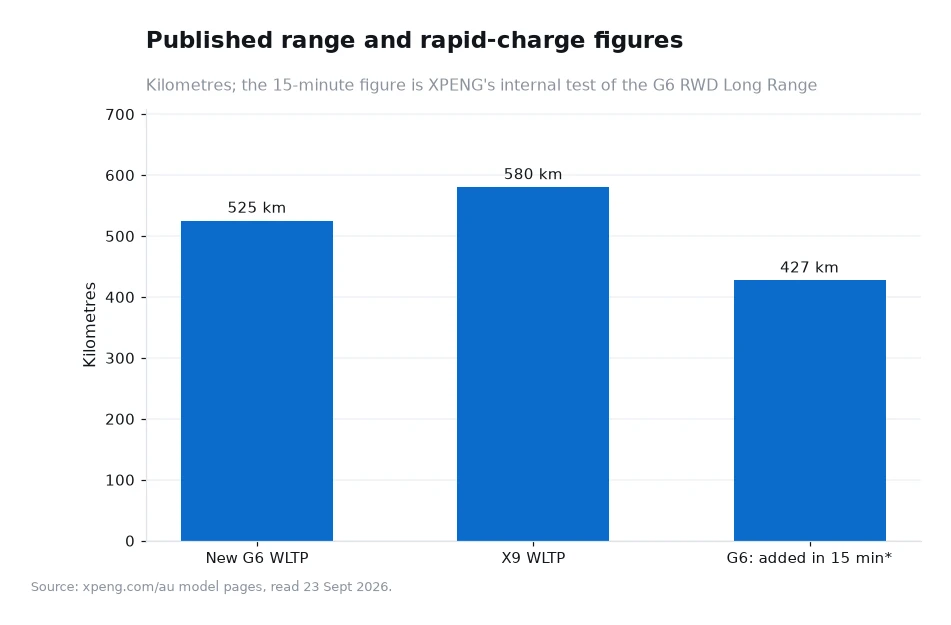
Australian buyers argue about whether a car is mid-size, large or a people mover, and the argument keeps restarting because the classes were built around older shapes. A modern line-up blurs them: the X9 is an ultra intelligent seven-seater MPV whose cargo space expands to 2554 L, while the New G6 is a coupé SUV with a published WLTP range of up to 525 km. Same country, same roads, very different answers to the question of how big a car feels.

Key takeaways
- Expanded cargo volume is 2554 L in the X9, a figure that sits closer to a van than a wagon.
- Published WLTP range is up to 525 km for the New G6 and up to 580 km for the X9.
- A fastback coupé roofline changes head room and the feel of space more than it changes the footprint.
- Class labels are a guide to comparison, not a measurement of what fits in your garage.
Three measurements that decide which class a car feels like
Boot volume is the first, and it is the one buyers quote. The second is roof height across the rear seats, which is what passengers actually notice. The third is width at the mirrors, which decides how a car behaves in a car park and in a school pickup queue.
Notice that length barely appears in that list. Wheelbase and total length define a class on paper, but they are rarely the reason a buyer rejects a car. What rejects a car is a boot that will not take a pram, a roof that makes a teenager duck, or a turning circle that makes the weekly shop irritating.
That is why a coupé SUV can be listed in one class and driven as though it belongs to a smaller one, and why a seven-seater MPV can feel enormous in a driveway and perfectly manageable on a highway.
Dual-cab utes made the same point a decade ago, and battery-electric models are making it again. A battery under the floor buys length and lowers the centre of gravity without stealing head room, but it also means the footprint of a car no longer predicts the space inside it. Two vehicles of identical length can differ by hundreds of litres of usable volume depending on how high the roof runs and how the seats fold away.
The class label still does one useful job. It tells you which cars a dealer will expect you to compare, and therefore which questions are worth asking on the day. It does not tell you whether your own garage, or your own weekend, will fit.
Why a coupé roofline reads smaller than it is
The New G6 is described on the Australian pages as a smart coupé SUV with a fastback silhouette, a long front overhang and a full-width integrated light bar. A fastback roof slopes towards the tail, which is efficient at speed and, in most cars, costs a little head room in the second row.
The X9 solves the same problem in the opposite direction. It is a seven-seater MPV with a one-touch electric fold-flat third row, and the site describes a submerged trunk design that fits seven suitcases with all seats occupied.
So the two cars sit in genuinely different classes, and a buyer who needs the space should be honest about which one they are shopping for. The coupé shape is the efficient one; the MPV is the capacious one.
What each measurement actually decides
| Measure | What it decides in practice | Example in the Australian line-up |
|---|---|---|
| Expanded cargo volume | Whether one trip replaces two | X9: 2554 L with the third row folded |
| Roofline profile | Head room and the sense of space in the rear | New G6: fastback coupé silhouette |
| Seat count and layout | Which class a buyer compares the car against | X9: ultra intelligent seven-seater MPV |
| Steering at low speed | How large the car feels in a car park | X9: active rear-wheel steering |
| Ride height control | Kerb clearance and levelling under load | X9: dual-chamber air suspension, six manual levels |
Worked example: loading a family weekend into 2554 L
Published volume figures are hard to picture, so here is an illustrative calculation with every assumption stated. The published input is the X9's expanded cargo figure of 2554 L with the third row folded; the item sizes are assumptions.
Assume a folded pram and a travel cot take 300 L together, a week of groceries for five people takes 120 L, and two large suitcases take 60 L each, so 2 x 60 = 120 L. Total load: 300 + 120 + 120 = 540 L.
Against the expanded figure, 2554 minus 540 leaves 2014 L of remaining volume, which is why a car of this size turns a two-car trip into one. Now run the same load with the third row up: the published claim is a submerged trunk that fits seven suitcases with all seats occupied, and if each suitcase is 60 L, seven of them are 7 x 60 = 420 L. That is the real limit to plan against when all seven seats are in use.
Distance matters too. Picture a 480 km round trip in a car published at up to 525 km WLTP. The arithmetic gives 525 minus 480 = 45 km of margin, which is thin for a loaded car at highway speed, so plan one stop. A single 15-minute stop covers the same distance in principle, based on XPENG's internal test of the G6 RWD Long Range that added 427 km of charge, and the X9 is published at up to 580 km WLTP for comparison.
Where the classes will settle
Two things are pushing the classes around right now. The first is the 800V silicon carbide platform shared by the New G6 and the X9, which makes a longer car quicker to recharge and therefore less of a compromise on a long trip. The second is the published strategy the manufacturer announced for the Australian market, which includes five new models in 2026 and Navigation Guided Pilot in 2027.
Neither changes the tape measure. What they change is the price of going bigger, in time rather than in fuel, and that is why the class boundaries look unstable to anyone comparing a coupé SUV with a people mover today.
Frequently asked questions
Is the X9 a people mover or a large SUV?
XPENG lists the X9 as an ultra intelligent seven-seater MPV, so on the published description it is a people mover rather than an SUV. Buyers often compare it with large SUVs because its cargo volume expands to 2554 L and it uses the same 800V platform family as the New G6.
Does a coupé roofline cost much space in the back?
A fastback roof slopes earlier than a boxy one, which mainly affects head room and the feel of the rear seats rather than the length of the car. Take your tallest rear passenger to the dealership and sit them behind the driver's seat at their own settings.
How to judge size in the car park
Reverse into a bay with a kerb, load the boot with the seats in the position you will actually use, and open the tailgate fully with the car parked near a wall. Then measure the space in your own garage with the door closed, not the space on the builder's plan.
If you are comparing the two shapes, read the X9 specification beside the model page for the suv cars australia range, then book time in both through Find a Dealer. The published figures are the starting point; the car park is the decision.
Cargo, range and feature details quoted here come from the manufacturer's Australian site at xpeng.com/au, read on 23 Sept 2026, where WLTP range is stated to depend on driving style, speed, passengers, load and temperature and the 15-minute figure is an internal XPENG test of the G6 RWD Long Range. The item volumes used in the example are the author's own assumptions. [1]