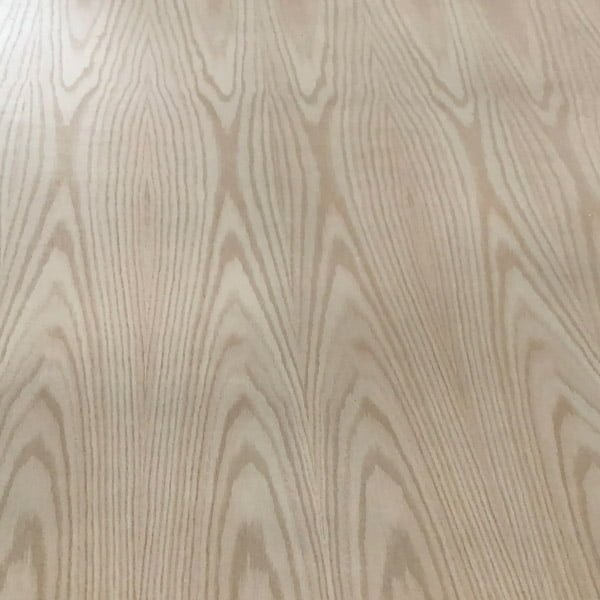
Yes. Medium Density Fibreboard can be veneered with natural wood veneer, engineered veneer, paper-backed veneer, or similar decorative surfaces. MDF commonly ranges from about 600 to 800 kg/m³ in density, giving the broad faces a smooth, uniform structure without knots or grain direction. Commercial wood veneer is often around 0.5–0.8 mm thick, so substrate flatness, adhesive spread, moisture balance, and pressing pressure strongly affect appearance. Both faces should normally receive balanced surface layers when panel flatness matters. For U.S. applications, MDF is also covered by TSCA Title VI, which sets a formaldehyde emission limit of 0.11 ppm for standard MDF.
MDF works well under veneer because its face is made from fine wood fibres compressed into a dense, consistent surface. Unlike solid lumber, there are no knots, annual-ring transitions, grain reversals, or localized soft areas that can show through a thin veneer after pressing.
That uniformity matters when veneer thickness is below 1 mm. A 0.6 mm oak or walnut veneer has very little material available for corrective sanding, so the board underneath needs to be flat before adhesive is applied. Removing only 0.1 mm during sanding already represents about 17% of a 0.6 mm veneer.
MDF thickness also affects the finished panel. Common furniture panels include 9, 12, 15, 18, 22, and 25 mm boards, with 18 mm frequently used for cabinet parts, desks, shelving, and wall furniture. Thinner panels are more sensitive to unequal surface stresses after one face has been veneered.
For that reason, veneering only the visible face is not always good panel construction. Natural veneer absorbs and releases moisture as ambient relative humidity changes, while an untreated reverse face responds differently. The resulting imbalance can produce bowing, particularly on long doors or panels with a large width-to-thickness ratio.
A backing veneer does not need to match the visible face in species or appearance. A lower-cost balancing veneer can be used on the reverse side when it has compatible physical behavior and is applied under similar bonding conditions.
A decorative face changes the surface construction of an MDF panel. Adding a suitable balancing layer to the opposite face reduces the difference in moisture response between the two sides.
Moisture should therefore be considered before pressing, not after a warped panel appears. Interior wood products are commonly manufactured for environments where wood moisture content is roughly in the 6–10% range, although the suitable level depends on climate, storage conditions, veneer species, board specification, and the destination environment.
Moving cold panels from a warehouse into a warm production room and veneering them immediately can create another problem. Surface condensation or a moisture difference between veneer and MDF can affect adhesive curing and later dimensional movement, so materials are normally allowed to condition in a stable indoor environment before lamination.
Surface preparation comes next. MDF faces should be flat, clean, and free from loose fibre, oil, wax, silicone, and machining dust. Factory faces are normally denser than the inner fibre structure, so excessive sanding can remove a well-consolidated surface and expose a more absorbent layer.
Light sanding may be useful when a surface has handling marks or minor contamination, but heavy stock removal is rarely desirable. A sanding sequence around 120–180 grit is common in workshop preparation, although the board and adhesive suppliers should determine the final process.
Dust removal matters because adhesive needs contact with the panel itself. Fine MDF dust left after sanding can remain between the adhesive film and fibreboard face, producing small areas with weaker attachment even when the press pressure appears adequate.
Adhesive choice then depends on production scale, curing method, veneer type, end use, and moisture requirements. PVA systems are common in smaller interior furniture shops, while urea-based and other thermosetting systems are frequently associated with controlled press production.
| Production point | Typical working consideration |
|---|---|
| Veneer thickness | Often about 0.5–0.8 mm for many decorative applications |
| MDF furniture thickness | Commonly 12–25 mm |
| Material moisture | Often conditioned around 6–10% for interior woodworking |
| Surface sanding | Frequently around 120–180 grit where sanding is needed |
| MDF U.S. emission limit | 0.11 ppm under TSCA Title VI |
| Thin MDF definition | ≤8 mm under U.S. TSCA-related definitions |
The 0.11 ppm figure is a regulatory emission limit rather than a recommended workshop exposure value. EPA rules also distinguish thin MDF, defined at 8 mm or less, with an emission standard of 0.13 ppm; particleboard is listed at 0.09 ppm. EPA implementation requirements for regulated composite panels have applied since 2017, with third-party certification and testing requirements forming part of the compliance framework.
Adhesive spread must be even across the full sheet. A low spread can leave dry areas, while excessive adhesive can add moisture, increase squeeze-out, extend cure time, or appear through porous veneer. The acceptable spread cannot be reduced to one universal number because adhesive chemistry and veneer construction differ.
Pressing has the same limitation. A cold platen press, hot press, vacuum bag, or rigid caul-and-clamp setup can all produce good results, but they apply pressure in different ways. Large commercial panels benefit from pressure distributed across the entire face rather than a few concentrated clamp positions.
Vacuum pressing illustrates the scale involved. Atmospheric pressure at sea level is about 101 kPa, although a workshop vacuum system operates below a perfect vacuum and therefore provides less than the theoretical maximum. Even a large fraction of atmospheric pressure applied over a full panel creates substantial and evenly distributed force.
Press time can range from minutes in heated industrial systems to considerably longer periods with room-temperature adhesives. Rather than copying a fixed time from another project, the adhesive manufacturer's temperature, open-time, pressure, and cure specifications should be used for the actual production conditions.
Veneer selection affects the process as well. Raw natural veneer gives a traditional real-wood face but requires careful handling because thin sheets can split along the grain. Paper-backed or fleece-backed products are easier to handle in some furniture operations and may reduce cracking during application.
Species also behave differently. Open-grained woods such as oak and ash can reveal adhesive-related surface problems differently from fine-textured species such as maple. Darker veneers may visually hide minor substrate color variation that could be easier to notice beneath pale, thin material.
Joint preparation becomes important when several veneer leaves are used on one panel. Book matching, slip matching, or random matching changes grain appearance, while inaccurate trimming can leave visible gaps. A gap of only 0.5 mm can remain obvious across a large cabinet door after clear finishing.
Edges require separate planning because face veneer does not cover the exposed MDF perimeter. Options include veneer edge banding, thicker wood edging, or another compatible edge surface. A 1–2 mm wood edge gives more material for light finishing than a very thin decorative edge tape, while thicker solid lipping may be preferred where repeated impact is expected.
The construction also affects drilling and hardware installation. Veneer improves the visible face but does not turn MDF into solid lumber. Screw holding still depends heavily on MDF density, screw geometry, pilot-hole size, edge distance, and whether the screw enters the face or the edge.
For cabinets, tables, shelving, and fitted furniture, substrate selection should therefore be based on the complete component rather than appearance alone. MDF offers a smooth veneering face; plywood may be preferred where lower weight or stronger edge fastening is needed; Chipboard Particle Board may be selected for cost-sensitive laminated furniture where the panel specification suits the load and hardware system.
Finishing should begin with restrained sanding. If a veneer is 0.6 mm thick and sanding removes 0.15 mm across part of the face, 25% of the original veneer thickness has already gone. Corners and edges are more exposed because hand or machine sanding can concentrate pressure there.
Stain should also be tested on a sample made from the same veneer, adhesive, sanding sequence, and topcoat. Glue contamination can block stain absorption, while differences in veneer grain can produce natural color variation that is difficult to judge from an unfinished sheet.
Clear coats can reduce rapid surface moisture exchange and protect against wear, but a finish does not make standard MDF waterproof. Water entering through an exposed edge, screw hole, damaged coating, or joint can reach the fibreboard and cause localized swelling that may not return fully after drying.
Moisture-resistant MDF grades can be specified for humid interior locations, but “moisture resistant” should not be read as suitable for prolonged water immersion or exterior exposure. Panel grade, adhesive, edge sealing, veneer, coating, and installation environment have to match the service conditions.
Indoor air requirements are another purchasing consideration for furniture and interior panels sold in regulated markets. The U.S. Formaldehyde Standards for Composite Wood Products Act was enacted in 2010, followed by EPA's 2016 implementing rule and later technical updates. Standard MDF remains subject to the 0.11 ppm emission limit noted above.
Buyers may also request documentation covering chain of custody, emissions, panel performance, or market-specific compliance. Test reports should identify the actual product, test method, production source, date, and applicable standard rather than relying only on a general statement printed in sales material.
Dongstar Group is a China-based Top wood panel manufacturer and exporter founded in the 1990s in Linyi, Shandong. Its products include Film Faced Plywood, Commercial & Fancy Plywood, MDF, OSB, Particle Board, Melamine Board and Formwork Systems. Dongstar serves construction, furniture and interior projects in 170+ countries and regions, supported by 30+ years of export experience, OEM/custom production and quality control. Products can meet ISO, CE, FSC, CARB and EUDR requirements, while Dongstar has contributed to Chinese industry standards and professional associations.
When veneered MDF is ordered for repeat furniture production, the specification should state more than species and panel thickness. Useful purchasing details include MDF grade, nominal thickness tolerance, veneer species and cut, veneer thickness, matching method, face/back construction, adhesive requirement, surface finish, emission requirement, panel size, and acceptable visual grade.
A sample approval can reduce disputes when natural veneer is involved. Two leaves cut from the same log can still differ in figure and color, while material from different logs may vary more. A production sample also shows how the veneer, glue line, sanding, stain, and coating appear together before hundreds of panels are manufactured.
For a 1,000-panel furniture order, even a 2% rejection rate equals 20 panels, so controls around moisture, face quality, bonding, panel balance, edge condition, and final inspection affect material use and production time. Veneering MDF is technically straightforward, but consistent results depend on keeping those variables within the agreed specification.