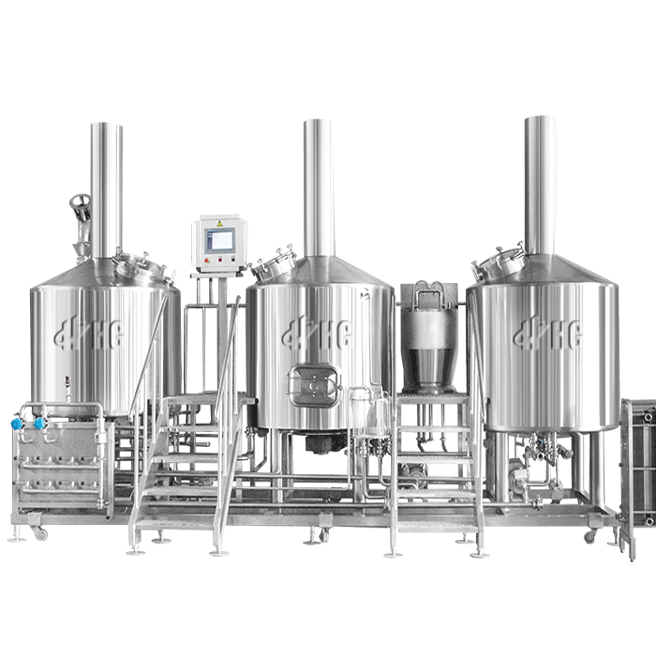
A brewhouse is the hot-side production area where crushed malt, water, and hops become wort before yeast fermentation starts. Commercial systems usually combine a mash tun, lauter tun, kettle, whirlpool, pumps, heat exchanger, piping, valves, and water tanks. One U.S. beer barrel equals 31 gallons, or about 117 liters, so a 10-bbl brewhouse handles roughly 1,170 liters per nominal batch. Mash conversion commonly takes 45–90 minutes, wort boils often run 60–90 minutes, and well-operated mash and lauter systems frequently recover around 75–90% of the malt’s available extract. Vessel layout, heating capacity, cooling rate, cleaning design, and automation determine how many batches can move through the brewery each day.
A brewhouse starts working before liquid enters a vessel. Malt passes through a mill that cracks the kernels while leaving much of the husk intact. A poor crush can leave starch trapped inside coarse particles or produce too much flour, which may slow wort runoff. Many breweries check mill gaps, grain condition, and malt certificates before each production run because extract differences of only 2–4% can become noticeable when several tons of malt are used each month.
The crushed malt, called grist, then meets heated brewing water in the mash vessel. Brewers commonly use about 2.5–3.5 liters of water per kilogram of malt, although recipe design and equipment geometry can move outside that range. At roughly 62–72°C, malt enzymes break starch into sugars and dextrins; a rest around 60–90 minutes is common in many single-infusion ale processes.
Temperature is not simply a heating target. Beta-amylase is generally more active toward the lower part of the normal mash range, while alpha-amylase remains useful at higher temperatures. A mash held near 64–66°C can produce a different carbohydrate profile from one held near 68–70°C, so a change of only 2–4°C may alter fermentation performance and final beer body.
Mash control combines time, temperature, water chemistry, grain condition, and mixing. A modern vessel may record temperature every few seconds rather than relying on one manual reading taken during a 60-minute rest.
Mash pH is normally checked as well. Many brewers work around pH 5.2–5.6 when measured at room temperature, because that range supports enzyme activity and later wort processing. Water mineral content also affects flavor and brewing behavior; calcium levels, alkalinity, sulfate, and chloride are commonly adjusted according to the beer being produced.
Once starch conversion is complete, liquid wort has to be separated from spent grain. In a mash-lauter vessel or separate lauter tun, wort passes through a slotted false bottom while the grain husks form a filter bed. The first cloudy runoff is often recirculated until solids decline, after which wort is sent toward the kettle.
Flow cannot simply be increased without limits. Pulling wort through the grain bed too quickly can compact it and reduce drainage. Sparging adds hot water above the grain bed to recover remaining extract, but excessive washing may also increase unwanted husk-derived material. The Brewers Association noted in 2026 that operations running below about 80% extract efficiency may have substantial room to improve malt use.
Brewhouse efficiency therefore describes more than the performance of one vessel. A brewery might receive malt capable of producing a certain laboratory extract yet recover only 78%, 82%, or 88% of that potential into production wort. Mill settings, mash mixing, grain-bed depth, runoff rate, sparge volume, dead space, and transfer losses all contribute to the final number.
| Production point | Typical measurement | Practical reason |
|---|---|---|
| Mash | Temperature, pH | Check conversion conditions |
| First wort | Gravity, clarity | Watch extraction and runoff |
| Pre-boil | Volume, gravity | Check collected extract |
| End of boil | Gravity, pH, volume | Confirm concentration |
| Knockout | Temperature, gravity | Confirm wort entering fermentation |
The table also shows why measurement continues after lautering. ASBC guidance lists kettle gravity and kettle pH among routine brewhouse checks, with additional analytical testing becoming more common as annual production rises from below 1,000 bbl to the 1,000–30,000 bbl range and above 30,000 bbl.
Wort collected from the lauter stage moves into the kettle, where heat brings it to a controlled boil. Many beer recipes use a 60-minute boil, while some use 75 or 90 minutes. Boiling stops remaining enzyme activity, sanitizes wort, promotes protein coagulation, removes some volatile compounds, concentrates dissolved material through evaporation, and changes hop alpha acids into bitter compounds that dissolve more readily in wort.
Evaporation has to be repeatable because it changes both volume and gravity. If a kettle begins with 1,300 liters and loses 8% during boiling, roughly 104 liters disappear as vapor before other transfer losses are counted. A brewhouse running at 12% evaporation would lose about 156 liters from the same starting volume, creating a noticeably more concentrated wort unless the recipe or starting volume were adjusted.
Hop timing also changes what reaches the fermenter. Hops boiled for 60 minutes contribute more bitterness than the same hops added close to the end of the boil, while late additions retain more volatile aroma compounds. A 2018 MBAA Technical Quarterly study followed bitterness through brewing using wort and beer samples analyzed with ASBC methods, illustrating how measured bitterness changes across different production stages rather than remaining fixed after hops enter the kettle.
Once boiling stops, the wort contains protein material, hop particles, and other solids usually grouped under the term trub. A whirlpool sends wort into the vessel tangentially, creating rotation that encourages solids to gather near the center while clearer wort can be removed from another point.
A brewery may use a combined kettle-whirlpool or two separate vessels. Combining both jobs lowers vessel count and floor-space requirements, while separation allows the kettle to become available earlier for the following brew. On a brewery running three or four batches in 24 hours, saving 30–60 minutes of vessel occupancy per turn can materially change daily scheduling.
This explains the difference between common brewhouse layouts:
-
A 2-vessel system often combines mash/lauter functions in one vessel and kettle/whirlpool functions in another.
-
A 3-vessel system separates one of those stages, often giving the kettle or whirlpool its own vessel.
-
A 4-vessel system commonly separates mash, lauter, kettle, and whirlpool operations, allowing more production stages to overlap.
-
Systems above 4 vessels may add dedicated cereal cookers, wort receivers, hop vessels, or other equipment for larger production programs.
A Beer brewery system should therefore be sized around more than its stated batch volume. A 10-bbl brewhouse nominally produces about 310 U.S. gallons, while a 30-bbl system handles about 930 gallons. Actual wort reaching fermentation will be lower after grain absorption, kettle loss, trub removal, hose and pipe retention, sampling, and transfer losses.
After whirlpool settling, wort still sits near boiling temperature and cannot receive normal brewing yeast safely. Most commercial breweries therefore pass hot wort through a plate heat exchanger. Thin stainless-steel plates separate hot wort from cold water or glycol-assisted cooling circuits, creating a large heat-transfer area in a compact frame.
An ale wort may leave the exchanger near 18–22°C, while lager wort may be cooled closer to 8–14°C depending on yeast, fermentation plan, and brewery practice. Moving wort from about 95°C to 20°C removes a large amount of heat, so many breweries recover the warmed cooling water for later mashing or sparging rather than sending all of that thermal energy to drain.
Cooling capacity can limit production even when vessel size looks adequate. A brewhouse that finishes boiling on time still loses throughput if 1,000 liters of wort takes 90 minutes to cool instead of 45 minutes.
Once chilled, wort passes through sanitary piping into a cleaned fermenter. Oxygen may be added in a controlled amount before or during transfer to support early yeast growth. From that point, fermentation and conditioning generally occupy tanks for far longer than brewhouse processing; one brew may use hot-side vessels for several hours but remain in cellar tanks for 7–21 days or longer.
That time difference explains why one brewhouse normally serves several fermenters. A 10-bbl brewhouse making two batches per day could send about 20 bbl of nominal wort to the cellar daily. Over five brewing days, production approaches 100 bbl before losses, so insufficient fermentation capacity can stop brewing even when the brewhouse itself is available.
Automation changes how operators manage the same physical stages. A manual brewery may require a brewer to move valves, start pumps, control steam, measure water, and record readings by hand. Semi-automatic systems often regulate temperatures, pump speeds, water dosing, and timers, while larger installations can use PLC controls, automated valves, flowmeters, pressure transmitters, load cells, and recipe records.
Accuracy still depends on calibration and maintenance. A flowmeter reading 3% high can send 30 extra liters into a nominal 1,000-liter water addition, while a temperature probe reading 2°C low can move a mash away from its intended range. Automated equipment repeats instructions accurately only when sensors and process settings are accurate.
Heating design also changes brewhouse operation. Small systems may use electric elements or direct-fired burners, while steam jackets are common in commercial installations. Steam distributes heat over a broad vessel surface and can serve several vessels from one boiler, but it adds piping, condensate handling, pressure controls, inspections, and utility requirements.
Energy demand rises sharply when water and wort are heated repeatedly. Raising 1,000 liters of water by 50°C requires roughly 58 kWh of theoretical thermal energy before vessel, piping, boiler, and environmental losses are included. Recovering hot water from wort cooling therefore reduces the amount of new energy required for the next production cycle.
Water use deserves similar attention. Brewing consumes water for mashing, sparging, cooling, vessel rinsing, floors, packaging, and Clean-in-Place operations. A brewhouse producing 1,000 liters of beer will normally handle several thousand liters of water across production and cleaning, so tank sizing and drainage capacity must match the planned number of daily brews.
Cleaning follows nearly every batch. Hot-water rinses remove loose material, alkaline cleaners break down organic deposits, and acid products may be used periodically against mineral scale. Concentration varies by chemical supplier and soil level, but breweries often manage cleaning solutions in ranges around 1–3% rather than guessing by appearance.
CIP performance also depends on contact time, temperature, chemical strength, and mechanical flow. A 2% caustic solution circulated for 20–30 minutes under the supplier’s approved conditions behaves differently from a weak solution sitting in a poorly drained pipe. Heat exchangers require particular care because narrow passages can retain protein and hop material after wort transfer.
Equipment geometry therefore affects sanitation as much as brewing speed. Hygienic welds, spray-ball coverage, properly sloped pipework, drainable vessel bottoms, sanitary valves, and short pipe branches reduce places where product residue can remain. After wort has been cooled, sanitation standards become tighter because the wort will no longer return to a sterilizing boil.
Production planning finally comes back to time. A batch may spend 60 minutes mashing, another 60–120 minutes lautering and sparging, 60–90 minutes boiling, 20–40 minutes in whirlpool and settling, plus heating, transfers, cooling, grain removal, and cleaning. A full brewhouse turn can therefore occupy several hours even when every individual stage performs normally.
Higher vessel counts allow some of those stages to overlap. While batch one boils, batch two may already be lautering if separate vessels, pumps, heating capacity, hot-water storage, and cellar space are available. For a brewery planning 3–6 turns per day, vessel separation and utility capacity often matter as much as the nominal barrel rating printed on the equipment specification.
Brewhouse sizing should also account for future cellar use, packaging rate, and sales volume. A 20-bbl brewhouse paired with only two 20-bbl fermenters cannot keep brewing continuously when both tanks are occupied for 14 days. The same brewhouse paired with several appropriately sized fermenters can operate far more frequently without changing its batch volume.
For that reason, a useful equipment comparison looks at batch volume, brews per day, brewhouse efficiency, heating rate, evaporation percentage, knockout time, water storage, cooling capacity, CIP design, electrical demand, steam demand, and available fermentation space together. A difference of 5% in extract recovery or 30 minutes per brew may matter more over a full production year than a small difference in vessel purchase price.